
Tubal Ligation Reversal Surgery
Tubal Reversal Coordinator
What Is Tubal Ligation Reversal Surgery?
Tubal ligation reversal is a procedure designed to restore fertility after a woman has had her “tubes tied.” During a tubal ligation, the fallopian tubes are blocked, cut, or sealed to prevent pregnancy. A reversal surgery reconnects the blocked portions of the fallopian tubes, allowing eggs to travel from the ovaries to the uterus again.
At NCCRM, this procedure is performed as an open surgery (not laparoscopic). That means your surgeon makes a small incision in the lower abdomen—similar to a C-section but half the size—to access and repair the fallopian tubes directly. This open approach enables the surgeon to work under magnification for precise, delicate repair of the tubes, giving patients the best possible chance for a successful outcome.
Recovery involves returning home the same day, with most patients resuming normal activities within two weeks. Our team provides detailed after-care instructions to ensure safe healing and maximize your chances of pregnancy.
Who is a Good Candidate for the Procedure?
Not every woman is an ideal candidate for tubal ligation reversal, and the likelihood of success depends on several factors:
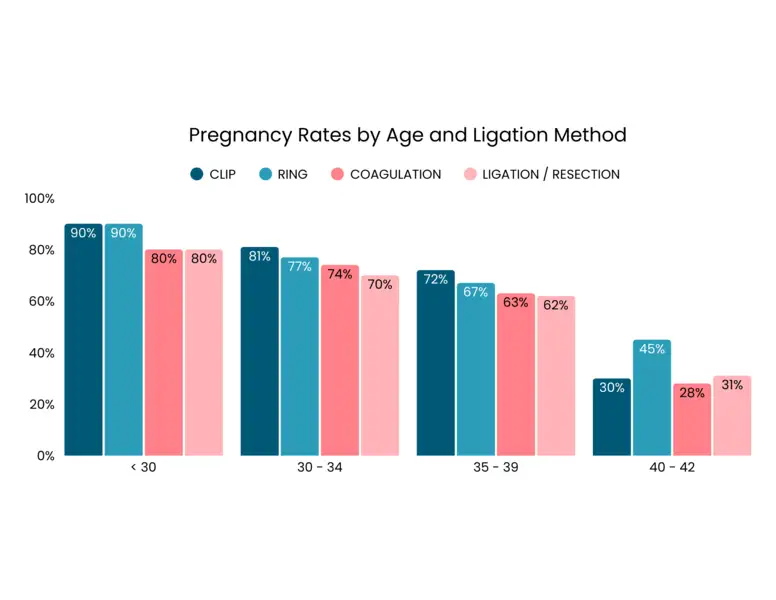
- Age: Younger women, particularly those under 35, tend to have higher success rates in conceiving after reversal due to better egg quality and ovarian reserve.
- Type of Tubal Ligation: The method used in the original tubal ligation procedure significantly affects whether a reversal will be successful. Women who have clips or rings placed on their tubes generally have a better chance of a successful reversal. In contrast, those who have had their tubes cauterized or undergone Pomeroy type ligation may face more challenges, depending on the amount of tube that was cauterized or removed. Although most of the time there will be enough tube remaining.
- Overall Health and Fertility: A woman’s overall health, including her uterus and the length of the remaining fallopian tubes, plays a critical role in the procedure’s success. Pre-existing fertility issues, such as low ovarian reserve or hormonal imbalances, may also affect the chances of pregnancy after reversal.
Getting Started With Tubal Ligation Reversal

Step 01 - Instant Quote & Eligibility
Start the review process to confirm your eligibility for tubal ligation reversal surgery. While many patients qualify, not everyone is a good candidate for a safe and successful outcome.
To begin, you’ll answer a few quick questions that help us determine whether you may qualify. You’ll also receive an instant cost estimate to help you plan your budget.
If your estimate looks good and you’d like to move forward, you’ll be directed to schedule a free no-obligation Discovery Call, where we’ll answer your questions and review next steps—including financing options.

Step 02 - Medical Records Review
Once you decide to move forward with surgery, the next step is to complete our Full Patient Information Form and sign a Medical Records Release so we can request and review your records.
After we’ve received your completed forms and medical records, our provider will confirm your final approval for surgery. At that point, you can begin a payment plan (if needed) and we can schedule your surgery date.
If Surgery Is Not an Option
In some cases, our medical team may determine that tubal ligation reversal is not the best option. If so, our surgical coordinator will call to explain the reasons and answer your questions. Decisions are made carefully, with over 30 years of experience guiding us to prioritize safety and the best chance of success. When reversal isn’t recommended, IVF is usually advised.
Types of Tubal Ligations
Bipolar Coagulation
Bipolar Coagulation is the most common method of laparoscopic female tubal ligation. This procedure uses electrical current to cauterize sections of the fallopian tube, limiting damage to the segment between two poles of electrically conducting forceps. Typically, 2-3 adjacent sites are coagulated, and about 2-5 cm of the tube is lost. This method is reversible, and pregnancy success rates after reversal are approximately 70%, depending on the extent of tubal damage.
Fimbriectomy
Fimbriectomy is a tubal ligation method that removes the portion of the fallopian tube closest to the ovary, preventing the ovary from capturing and transferring eggs. Reversal involves opening the remaining tube and reshaping the inner lining to restore egg capture. However, this procedure has the lowest success rates for reversal; repairing is generally not recommended. In such cases, in vitro fertilization (IVF) is the preferred treatment option.
Irving Method
The Irving method of tubal ligation involves placing two ligatures around the proximal to mid-segment of the fallopian tube and removing the segment between them. The end of the tube connected to the uterus is sutured into the back of the uterus, while the other is buried in the connective tissue beneath the tube. This method differs significantly from other tubal ligation techniques. While reversible, the success rates for reversal are generally lower than those of different methods. However, if the remaining segments are healthy, pregnancy success rates can reach approximately 70% after reversal.
Monopolar Coagulation
Monopolar Coagulation, a less common tubal ligation method compared to Bipolar Coagulation, uses electrical current to cauterize the fallopian tube. Unlike the bipolar method, the radiating current in monopolar coagulation can extend beyond the coagulation site, potentially damaging a larger portion of the tube. In many cases, the tubes are also cut after cauterization. Due to the extent of damage, this procedure can significantly reduce pregnancy rates to approximately 45%. Success rates can reach 70% if the remaining tubal length exceeds 5 centimeters. This type of tubal ligation is reversible, and the tubes can often be repaired effectively.
Filshie
The Filshie or Hulka Clip technique involves applying a permanent clip to the fallopian tube. Once applied and fastened, the clip prevents the transference of eggs to the ovary. This procedure is best for reversal and pregnancy success, which can be as high as 85%. Fun fact: Dr. Toma learned the art of tubal reversal from Dr. Jaroslav Hulka, the inventor of the Hulka clip. Under Dr. Hulka’s mentorship, Dr. Toma gained expertise in using the Hulka clip and techniques for reversing and repairing tubal ligations—knowledge he has refined and perfected for over 30 years.
Falope Ring
The Silastic band, or Falope ring method, involves doubling over the fallopian tube and applying a band to cut off the blood supply. This leads to scar tissue formation, which separates the damaged section of the tube from the healthy portion to prevent pregnancy. This reversible procedure is offered at our facility, and pregnancy success rates can be high if minimal tube damage has occurred.
Pomeroy
This method of tubal ligation, often referred to as “cut, tied, and burned,” involves creating a loop of the fallopian tube, securing it with a suture, cutting the loop, and cauterizing (burning) the ends. Despite the cauterization, this method is highly suitable for reversal, as the burned ends are removed during the tubal reversal procedure. The remaining healthy tube sections typically allow for successful repair and fertility restoration.
Essure and Adiana
The Essure method involves placing two small metal and fiber coils in the fallopian tubes. Following insertion, scar tissue forms around these coils, blocking the tubes to prevent sperm from reaching an egg. The Adiana method involves placing two small silicone inserts into the fallopian tubes. During the procedure, a small section of each fallopian tube is heated, and the silicone pieces are inserted. Over time, scar tissue forms around the inserts, effectively blocking the tubes and preventing sperm from reaching the egg, thereby providing permanent contraception.
Need More Information?
Are you eligible for ligation surgery?
Wondering if tubal ligation reversal is right for you? Take our quick eligibility quiz to see if you may be a good candidate for a successful surgery. This simple first step helps you understand your options and sets the stage for your journey forward.

Curious about the cost?
Use our calculator to receive an estimate tailored to your unique situation. Your personalized estimate is based on the accuracy of your answers and provides a helpful starting point for planning.
The first step toward surgery is a medical review.
Complete a medical review form, and one of our providers will carefully evaluate your information to confirm whether you are approved for surgery. This step ensures your safety and helps us create the most effective treatment plan for you.
Tubal Ligation Reversal Success
What Success Means
In this context, success means achieving pregnancy—not simply restoring anatomical continuity. At NCCRM, many patients become pregnant within the first year after surgery. However, the timing and likelihood depend on the same factors listed above (age, tube condition, overall fertility health).
How Success Rates Work
Tubal reversal success depends heavily on several personal factors. As women age, the chances of success typically decline. Other important influences include the ligation method, the amount of tube remaining to reconnect, the location and condition of the cut ends, and other reproductive health factors that may affect conception. Because these variables vary from person to person, success rates for tubal reversal are best understood as ranges and probabilities rather than guarantees.
Pregnancy After Surgery
For many, natural conception is possible after the surgery, especially within the first year. Because conception is via natural ovulation and fallopian tube function (if restored), there’s no need for medically assisted fertilization in many cases. Importantly, if a woman misses a period or suspects she’s pregnant after reversal, prompt evaluation is critical. Because the fallopian tubes were surgically altered, there is a higher risk of ectopic pregnancy. With early detection, ectopic pregnancies can usually be treated medically (without surgery), often preserving the fallopian tube.
What To Do When You Achieve Pregnancy
MISSED PERIOD
Take a home pregnancy test when you miss a period.
IF POSITIVE
If positive, get a quantitative (blood) HCG test.
MONITOR
Repeat HCG levels every other day (for at least 3 measurements) to ensure they rise appropriately.
CONFIRM
Schedule a transvaginal ultrasound to confirm the embryo is located in the uterus—not in a tube.
FAQ For Tubal Ligation Reversal Surgery
What is tubal ligation reversal surgery?
Tubal ligation reversal (also called tubal anastomosis) is a procedure to restore fertility after a woman has had her tubes blocked, cut, or sealed. The surgeon reconnects the healthy ends of the fallopian tubes so that eggs can once again travel from the ovaries to the uterus.
How long does the surgery take?
The procedure usually takes 1.5 to 2 hours and is performed as outpatient surgery, meaning you go home the same day.
How is the surgery performed?
NCCRM uses an open microsurgical approach with an incision in the lower abdomen (smaller than a C-section). The tubes are carefully rejoined with fine sutures to restore function.
Why is liposuction necessary in some cases?
Too much adipose tissue (fat tissue) makes elevating the tubes from the abdomen more challenging, and the surgery may be compromised, thus lowering pregnancy success rates. Liposuction removes excess fatty tissue, allowing for easy access and smooth surgery, which in turn increases the success rate of the procedure.
Who is a good candidate for reversal?
Candidacy depends on:
- The type of tubal ligation performed
- How much healthy tube remains (ideally at least 5 cm)
- Patient age (younger patients have higher success rates)
- Overall reproductive health (e.g., ovarian reserve, uterine health, partner’s fertility)
What if I don’t have enough tube left?
If not enough healthy tubal tissue remains or if the tubes are too damaged, reversal may not be possible. IVF may be recommended instead.
Can I still have a reversal if I had a C-section, fibroid surgery, or other abdominal surgery?
Yes, but prior abdominal surgeries may make the reversal more complex. Your doctor will review your history and advise on risks.
What are the chances of pregnancy after tubal reversal?
Success rates vary, but NCCRM reports an average of 55% pregnancy success, depending on factors like age, type of ligation, and tubal length.
Does age affect success?
Yes. Women under 35 generally have the highest success rates, while women over 40 may have lower chances.
How soon can I try to get pregnant?
Most patients can begin trying within two weeks after surgery, once they feel comfortable. However, it may take up to a year to conceive naturally.
What if I don’t get pregnant after a reversal?
If pregnancy does not occur within 6 months, your provider may recommend fertility testing or treatments such as IVF.
What are the risks of the surgery?
As with any surgery, risks include bleeding, infection, and complications from anesthesia. Scar tissue may also form around the tubes, which can reduce success.
What is the risk of ectopic pregnancy?
There is an increased risk of ectopic pregnancy (pregnancy outside the uterus, often in the tube). Patients should seek medical care immediately if they experience pain or bleeding after a positive pregnancy test.
Can I have my fibroids removed during my ligation removal surgery?
Fibroid removal (myomectomy) can be done during the tubal ligation reversal procedure.
Will I need liposuction for the surgery?
Sometimes, if there is excess abdominal fat that limits the ability to elevate the tubes out of the abdomen liposuction may be performed during surgery to improve visibility and outcomes.
What is the recovery time?
Most patients need about 2 weeks before returning to normal activities. Some soreness and fatigue are expected, and strenuous activity should be avoided until cleared by your provider.
Will I need someone with me?
Yes. Because of anesthesia, you’ll need someone to drive you home after surgery and to help during the first day of recovery.
How much does reversal surgery cost?
Tubal Ligation Reversal cost at NCCRM typically includes:
- Initial consultation
- Ultrasound
- Surgery and anesthesia
- Pre-op and post-op visits
Additional costs may apply for labs (bloodwork, ovarian reserve testing), prior surgical complications, or liposuction if required.
Does insurance cover tubal reversal?
Usually not. Most insurance plans, including Medicare and Medicaid, consider it elective and do not cover the procedure.
Are financing options available?
Yes. NCCRM offers several financial plans to make surgery more affordable.
What if reversal isn’t possible?
If the tubes cannot be repaired, in vitro fertilization (IVF) is the main alternative.
How does tubal reversal compare to IVF?
- Tubal reversal allows multiple chances for natural conception each month after recovery.
- IVF bypasses the tubes altogether, but involves higher costs, hormone injections, and lab procedures.
- Your provider will help decide which is best for your situation.
Can I come from out of state for surgery?
Yes. NCCRM welcomes out-of-state and international patients. Many patients fly in for reversal surgery.
Does NCCRM act as a monitoring site for IVF or other fertility patients?
Yes. NCCRM partners with other fertility clinics nationwide and also provides monitoring services for patients traveling from different areas.
How soon will I have a period after surgery?
Most women resume their menstrual cycles within 4–6 weeks, depending on when the surgery was done in their cycle.
Will the surgery leave a big scar?
No. The incision is typically smaller than a C-section scar and placed low on the abdomen.
Can both tubes always be reconnected?
Not always. Sometimes only one tube can be repaired, but pregnancy is still possible with one functioning tube.
What if I had an Essure or Adiana procedure?
Essure removal and similar types of sterilization are more challenging to reverse. NCCRM evaluates each case individually, and IVF may be recommended.